
Jessica Said, Project Symphony Member Shares PFAS Research on National Stage

Sunghee Lee • March 27, 2026

We’re excited to share some big news from our Project Symphony family!


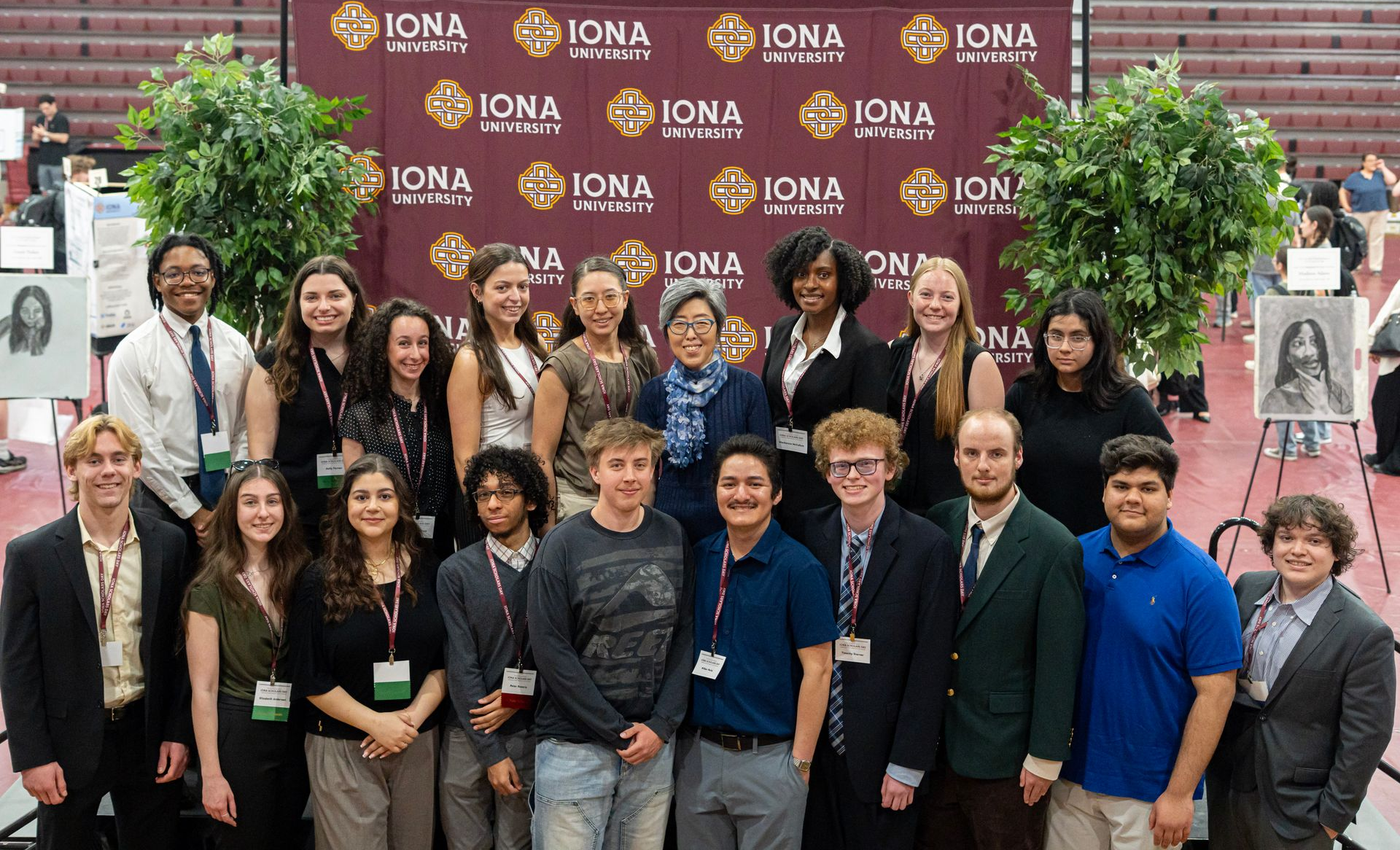
This spring, our own Jessica Said ’26, was selected as one of only six undergraduates from across the country to speak in the ACS Presidential Symposium, “The Next 150 Years of Undergraduate Research,” at the Spring 2026 ACS National Meeting in Atlanta, GA. She gave her invited talk on March 23, representing both Iona and Project Symphony on a national stage.


Jessica has been part of Project Symphony since her freshman year, working long hours in the lab with fellow PS members. Her talk, “The Cellular Cost of Forever Chemicals,” looked at how PFAS (“forever chemicals”) can harm both mammalian and bacterial cell membranes. Using experiments carried out right here in the Project Symphony lab, she showed how these compounds can disrupt the structure and function of lipid bilayers, raising important questions for human health and environmental safety. Much of what she presented has already appeared in two peer‑reviewed publications coauthored with other Project Symphony members and Dr. Lee.


Dr. Lee shared how meaningful this achievement is: “I am so very proud of her accomplishment. Her level of dedication in research far surpasses what is typically expected of an undergraduate student.” Dr. Lee also often reminds us that staying engaged in research over multiple semesters and summers is what helps Project Symphony students build resilience, patience, and real scientific rigor—skills that carry far beyond the lab.


Being invited to speak in an ACS Presidential Symposium is a huge honor, and the undergraduate spots are extremely competitive. Jessica’s selection is a testament not only to her hard work, but also to what an all-undergraduate group can accomplish when we work together like a well-rehearsed ensemble.


For all of us in Project Symphony, seeing one of our own step up to the microphone in Atlanta and share our collective work felt like hearing a solo emerge from the middle of a larger performance: one clear voice, supported by the whole group behind it.


Stay tuned—there’s much more music to come from Project Symphony.

By Sunghee Lee February 23, 2026
We’re pleased to announce our new collaborative publication, “Study of the Interaction Between Graphene Oxide and Cholesterol Using Different Artificial Membrane Models,” conducted in partnership with colleagues in Italy. This work investigates how graphene oxide—an emerging nanomaterial with biomedical promise—interacts with cholesterol within lipid membranes. By employing various artificial membrane systems, we examined how membrane composition and organization influence these interactions, revealing key insights into the physicochemical mechanisms at play. Our results contribute to a deeper understanding of how nanomaterials engage with biological membranes, providing valuable guidance for the safe and effective design of graphene-based biomedical applications. Congratulations to all team members and our Italian collaborators on this exciting achievement! The full article is available here: https://www.sciencedirect.com/science/article/pii/S0021979726002821 .
By Sunghee Lee February 23, 2026
In this study, we explored how the membrane environment shapes the behavior of serotonin, a key neurotransmitter involved in mood regulation and neural signaling. By systematically varying lipid composition in model membranes, we uncovered how differences in lipid charge, fluidity, and packing influence serotonin’s nonspecific interactions with bilayers. Our findings shed new light on the physical chemistry of neurotransmitter–membrane interactions, with potential implications for understanding serotonin’s diverse physiological functions and its role in receptor signaling. Congratulations to all co-authors for their outstanding work and collaboration! The article can be accessed here: https://pubs.acs.org/doi/full/10.1021/acsptsci.5c00767
By Sunghee Lee November 15, 2025
Our research team has uncovered new details about how small oil-like molecules influence the thickness and flexibility of cell membranes. These membranes, built from layers of lipids, contain tiny pockets of free space that help control how soft, dense, or permeable the membrane is. Our research team found that some smaller molecules can fit into these layers, making the membrane thicker, while larger or crystallizing ones get pushed out, leading to thinning. These changes help explain how different molecules inside a membrane affect its overall structure and function. This study not only expands our understanding of how biological membranes work but also points to new possibilities for creating custom-designed synthetic membranes for research and technology. Read more details here: https://pubs.acs.org/doi/10.1021/acs.jpcb.5c06296 Congratulations to the Project Symphpony team for their exciting findings and continued dedication to advancing membrane science!
Show More